
Open
Desire, Damage, and What I Mistook for Love

A married friend of mine was talking about a woman we both know. Smart, funny, warm, self-aware. Someone who has a lot going for her. “I just don’t understand,” my friend said, genuinely baffled, “how she keeps ending up in these situations. She’s so amazing. How does she not see it?”
I knew exactly what she meant. I, too, was smart, funny, self-aware, yet had lost myself in far too many unfulfilling relationships. I was only now finally beginning to understand why.
I’ve always considered myself sexually open. Candid and unafraid, relatively speaking. In early 2000, I co-hosted a friend’s TV series about sex and relationships, called My Messy Bedroom. I really thought I was being so honest and brave. And I was, I guess. In retrospect, if I’m truly being honest, beneath it all was the underlying fear that I was too much or not enough. And, in reality, I rarely articulated my true sexual desires. As direct as I tried and considered myself to be, there was always a slightly performative aspect to my approach to sex. Pretending to enjoy it even when I didn’t. Pretending to be chill even when I wasn’t. It saddens me to think about it now.
At age 20, post Montréal massacre and a sexual assault in Greece the previous summer, I dropped out of university to follow an artist across the country. Despite how much he said he loved me, he believed monogamy was outdated and restrictive. He wanted his freedom and convinced me, too, that wanting anything less was narrow-minded. And so, reluctantly, I agreed to an open relationship. This was before ethical non-monogamy became common language, before we had frameworks, agreements, or even the vocabulary to describe what we were doing. We never set boundaries or rules, nor did we discuss how to navigate them. He just slept with other women, while I essentially stayed faithful. I told myself I was being progressive, evolved. The truth is, I was just afraid to lose him. And so, I adapted, put his needs before mine, again and again, and it cost me more than I realized.
This imbalance, I realize now, is present in so many relationships. One person compromising their needs for fear of losing the other. As women, especially straight women, we’ve been trained to accept accommodation over abandonment. We’ve been told, in a thousand explicit and implicit ways, to be chill, compliant, to not be too much. To prioritize men’s needs. To be grateful for their desire, even when it costs us.
Despite identifying as a feminist, coming of age in the era of riot grrrls, years of therapy, and knowing better, this conditioning persists. It lives in our bodies. We learn early what happens when we take up too much space.
Throughout my twenties and thirties, I repeatedly found myself in relationships that were imbalanced in this way. I always wanted more, gave more, abandoned parts of myself. From the binge drinker who disappeared for days at a time to the musician who wasn’t over his ex, to the writer who loved my industry contacts more than me. Each time, I’d tell myself a different story. Rationalize the uneven dynamic. Love is complicated, after all. Relationships live in the grey zone. I never saw that I was simply following a pattern so ingrained I’d mistaken it for my own personality. The erosion of myself was rarely dramatic, but the steady chipping away was insidious.
In my forties, I met a man at an event who was engaged, soon to be married. He was quick to assure me they had “an arrangement.” Phone calls were permitted, as long as nothing happened in person. And it never did, but we spoke frequently, at times daily. Our calls soon escalated from basic flirtation to dominance and submission, ultimately devolving into some pretty degrading role play. At first, it felt, admittedly and unexpectedly, dangerous but thrilling, in that way that shame and desire can sometimes become entangled into one.
Despite the initial rush, I soon realized this was his kink, not mine. I stopped enjoying the roleplay, but I still loved his attention and being desired by him. At some point, I even convinced myself I loved him. The rest became something I performed, that I endured.
The moment this became clear to me, something clicked. I’d been here before. Many times. In varying forms. Shaping myself to fit someone else’s desires. Making their needs feel like mine. Prioritizing their sexual fulfilment over my own. Pretending it was love. What it really was, I now understand, was a deeply programmed survival strategy.
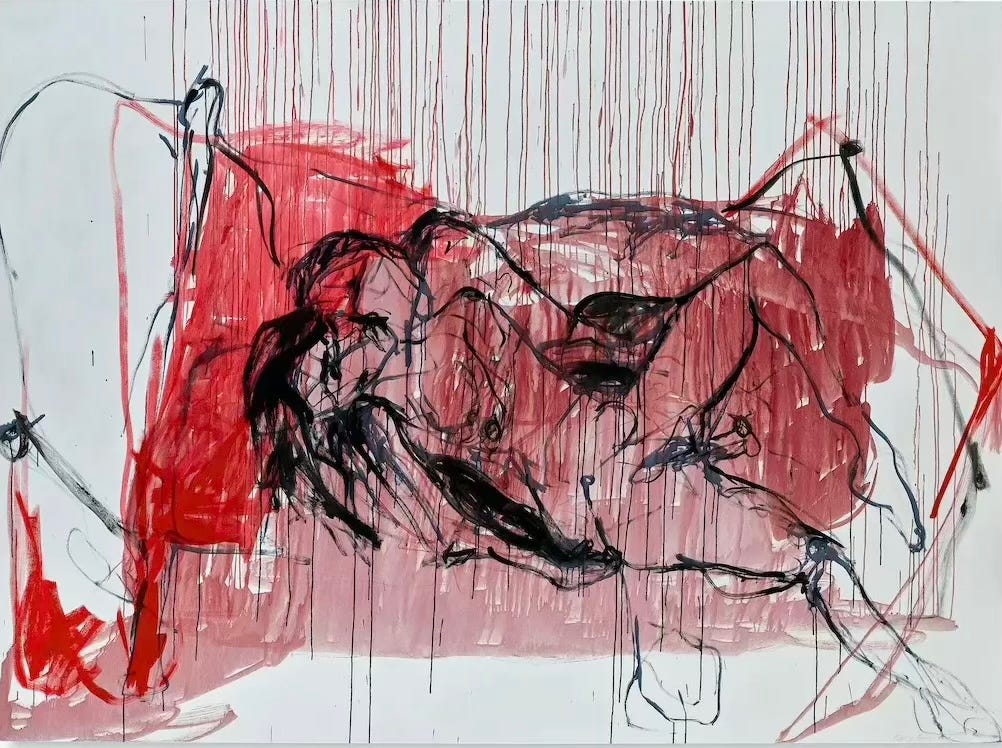
Years later, a repressed childhood sexual trauma began to resurface that demanded reckoning. An event whose impact I’d carried and suspected for decades, but had never fully acknowledged. Once I did, certain things became crystal clear: my attraction to unavailability, the way I confused intensity with intimacy, the way being held at arm’s length felt, paradoxically, like the right amount of closeness -- familiar, manageable, something I knew how to navigate safely. And why, for me, intimacy was always laced with a certain amount of fear.
Therapy taught me about attachment styles. My behaviour aligned with being anxiously attached, drawn to avoidant partners. It told me I was recreating early relational patterns. But it never took into consideration this underlying sexual trauma. How it had wired shame and desire together within me at an age too early for me to understand. How it taught my body to associate arousal with secrecy, fear, and diminishment. How my body held it somatically, even if my mind survived by dissociating for most of my adult life.
My last relationship was a five-year on-and-off situationship with a man I believed I loved. He’d come off a twenty-year marriage and made it clear he was not interested in commitment. I accepted this, even while it triggered me, even when I knew, once again, it was costing me dearly. That, once again, I was mistaking longing for love, and accepting that the ache of an almost-relationship was all that I deserved. Once again, convincing myself that, if I just stayed long enough, was patient enough, low-maintenance enough, the door to being fully loved would eventually swing open.
Of course, it didn’t.
I’ve finally come to understand that this pattern was never really about any of these men. The artist in my twenties, the degrading phone calls, the lifetime of imbalanced relationships. The pattern was formed out of what I’d learned, very early, about my worth, and became tied to a profoundly distorted idea of love and desire. A heady mixture of confusion and pain, layered with thick, sticky shame and piled with cultural messages from a society that both sexualizes and shames young girls, tells us we asked for it, or we’re teases, that we’re too much or not enough, frigid or easy. Never empowered. Never taught to trust our bodies. Never encouraged to trust our desire. Taught to perform in socially acceptable ways and to call that intimacy.
Ironically, I did have relationships with men who were loving and steady, who wanted to fully commit. I walked away from those. Told myself something was wrong, missing. What was missing was that familiar ache. I simply didn’t know how to receive love that didn’t cost me. Safety didn’t register as love.
I’ve been fully single for over five years now, and it has genuinely been the most healing period of my life. I’ve learned what it feels like to not be constantly braced for disappointment and heartbreak. To not be reacting to someone else’s ambivalence. To not be carrying a man’s emotional burden. Most importantly, I’ve learned to prioritize my wellbeing and needs, to take up space without calculating the cost.
There’s a growing movement of women declaring to be single by choice, yet in our society, being partnered remains proof of a successful life, even when it comes at a cost. A woman choosing herself, fully, in a culture that still pities (though I suspect, actually fears) a woman alone, is an act of bravery. Being single isn’t the wound. For many of us, it’s the state in which we finally heal.
When I read about Epstein, Gisèle Pelicot, and a rape academy with over 62 million visits per month, when I look at the stats, at how rarely we believe victims, and how few men are held accountable, it makes me acutely aware of how many of us are walking around, unaware of the sexual trauma we’re carrying. Of how many other women have spent decades performing desire, managing men’s needs, accepting less, and never making the connection to something that may have happened to them, nor giving themselves permission to even name it.
So, when my friend asks how our brilliant, self-aware friend could keep ending up in these situations, here’s what I want to answer: Because our intelligence has little to do with it. Because our self-awareness, as hard-won as it is, doesn’t automatically undo our wiring. Because some of us spend our formative years learning that our bodies aren’t fully our own. That desire is something that happens to us, not something we get to claim. That love is something we have to earn by shrinking and distorting ourselves.
Being sexually assaulted as a child doesn’t just mark you. It rewires your instincts, your ability to trust. It shapes how you move through the world and toward other people. Our bodies hold memories even when we can’t access them, even when our survival depends on not remembering. We’re just beginning to understand its full scope.
Which is why “she’s so smart, how does she not see it?” might be the least useful question we can ask. The more useful questions are these: What happened to her? And why did we make it so difficult for her to both acknowledge and speak about it?
How do we rebuild trust after it’s been deeply ruptured? How do we create genuine safety in relationships when it was never modelled or guaranteed? How do we achieve balance and equity within an oppressive, patriarchal system in which violence against women continues to be a real threat?
These are the questions that need to be asked.
You are brilliantly beyond awareness itself, you are steeped in your practice and birthright to embodying your worth, value, and beauty without compromising. This piece is a beacon of hope for (and a testament to) how one can transform old learned (and ingrained) patterns into ways of life that deeply serve —not only the individual but the whole of the collective. Thank you dear Isabelle. You are easily most lovable and desirable through my eyes.
It’s remarkable to consistently pick up your writing and read my own story to a T. Shocking someone; this one hit hard. Tx for the open sharing . You’ve moved vulnerability thru safety channels and now
You can guide thru your wisdom and I am soaking every last drop
Thanx for your endless talent on so many levels …. Now that’s gotta include the right brain too right ?
Xx